
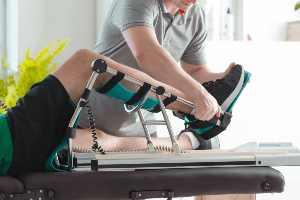
 Knee-replacement surgery is a common surgical procedure to help reduce pain and improve mobility to a knee damaged by arthritis. Although most people are able to make a full recovery after undergoing this type of surgery, some people may become disabled due to knee-replacement complications.
Yes, disability benefits are possible after knee replacement surgery if ongoing pain, mobility limitations, or complications prevent full-time work. Social Security evaluates medical records, recovery progress, physical restrictions, and whether the condition limits substantial gainful employment for the required duration under federal disability standards.
These complications may include persistent knee pain, implant failure, infection, knee stiffness, swelling and limited mobility. A second surgery or revision may be needed, but this can also cause severe complications that affect a person’s ability to return to his or her previous job or work at all.
If knee-replacement surgery has left you disabled and unable to work, you may be able to obtain disability benefits. However, not everyone who files a disability claim is approved by the Social Security Administration (SSA). Certain criteria must be met to increase your chances of getting benefits.
An Oshkosh Social Security Disability lawyer is ready to help. An initial consultation is free of charge.
Call (920) 260-4528 for a Free Case Review.
Meeting or Equaling a Listing in the Blue Book
The SSA evaluates knee-replacement complications by looking at whether or not a claimant is totally or permanently disabled. This is done by comparing a claimant’s symptoms to an impairment listed in the Blue Book. Your impairment must be serious enough to meet the criteria, such as clinical and lab tests.
it is important to talk to your doctor about your limitations. The more he or she can include about your limitations in clinical testing, observations and opinions in your records, the better chance for your claim to be approved. Most knee replacements are deemed successful, with people recovering within a year. You need sufficient medical evidence that your impairment has lasted or will last for at least a year.
The medical criteria for knee replacements can be found under Section 1.17 (Reconstructive surgery or surgical arthrodesis of a major weight-bearing joint). To meet or equal this listing in the Blue Book, your knee problems must cause severe physical limitations, such as difficulty walking or climbing stairs.
The following documentation must be submitted to the SSA:
- Record of having knee replacement surgery on one or both knees
- Notes from your doctor regarding your difficulty moving due to knee problems
- Evidence of your inability to walk without a wheelchair or another assistive device
This listing does not apply to knee replacements that were unsuccessful years after surgery. You must be able to prove that your difficulty moving started soon after undergoing knee-replacement surgery. This includes a reasonable amount of time between your recovery and rehabilitation.
If you have experienced persistent knee pain and limited mobility years after surgery, you may be able to qualify for disability benefits under Section 1.18 (Abnormality of a major joint(s) in any extremity).
To meet or equal this listing, you must have:
- Chronic knee pain or stiffness
- Abnormal motion, instability, or immobility in the knee
- This abnormality recorded on a physical examination or imaging test
- An inability to walk without a wheelchair or another assistive device
Medical Vocational Allowance for Knee Problems
Most people with knee problems or those whose knee-replacement surgery was unsuccessful may not meet the criteria in the Blue Book. This can happen even if they are in severe pain and unable to work.
If this is the case, you may be able to qualify for a medical vocational allowance. The SSA will look at your medical records to determine how your knee problems post-surgery affect your ability to work and perform daily tasks. If you are unable to maintain gainful employment, you may be awarded benefits.
The SSA will also determine the type of work, if any, that you may be reasonably able to perform with your disability. This is known as your Residual Function Capacity (RFC). For instance, your RFC may show that you can only stand for a few hours or cannot climb stairs without help due to your knee problems.
Evidence Related to Knee-Replacement Surgery
Sufficient medical evidence of your knee-replacement surgery must be submitted to the SSA, such as your knee diagnoses, any X-ray, MRIs or CT scans, and notes taken before and after surgery. A licensed lawyer at our firm is prepared to help you gather this evidence for you from your treating doctor.
Your medical records should include the following:
- How long you can walk
- Whether you need an assistive device
- How long you can stand
- If you can bend, kneel or crouch
- Whether you can lift or carry heavy items
- If you can climb stairs without assistance
Additionally, the SSA will want information on the kinds of treatments you have undergone since knee-replacement surgery. This may include pain medication, physical therapy and/or rehabilitation and therapeutic injections. Be sure to let the SSA know if you have experienced any side effects as a result.
FAQs About Disability Benefits After Knee Replacement Surgery
Can knee replacement surgery qualify for Social Security disability benefits?
Yes, knee replacement surgery can qualify for Social Security disability benefits when ongoing pain, mobility limits, or surgical complications prevent sustained full-time work. The claim must show medical proof of functional restrictions, treatment history, recovery limitations, and the inability to perform past work or other available jobs.
What evidence helps prove a disability claim after knee replacement surgery?
Evidence for a knee replacement disability claim should include surgical records, imaging, physical therapy notes, pain documentation, assistive device use, and doctor-imposed work restrictions. Social Security evaluates whether those records prove lasting limitations. Sigman Janssen Injury & Disability Lawyers can help organize the evidence around the disability standard.
Can chronic pain after knee replacement support an SSDI claim?
Yes, chronic pain after knee replacement can support an SSDI claim when it limits walking, standing, sitting, lifting, or reliable attendance. The legal issue is whether the pain creates work-preclusive functional limitations. Medical records should document the severity, duration, treatment response, and impact on daily and work-related activities.
What if my knee replacement was caused by a workplace injury?
A knee replacement caused by a workplace injury can involve both workers’ compensation issues and a Social Security disability claim. Workers’ compensation focuses on work-related causation and benefits, while SSDI focuses on the ability to sustain employment. Sigman Janssen Injury & Disability Lawyers can review how the injury history affects the disability claim.
Can a car accident that leads to knee replacement create a legal claim?
Yes, a car accident that leads to knee replacement can create a personal injury claim if another party’s negligence caused the crash and resulting knee damage. The claim may involve medical expenses, lost income, pain, disability, and long-term limitations. Liability and damages must be supported by crash evidence and medical records.
How does Social Security evaluate walking and standing limits after knee replacement?
Social Security evaluates walking and standing limits by reviewing medical records, physical therapy progress, assistive device use, pain reports, and residual functional capacity. These limits matter when they prevent past work or other jobs. Sigman Janssen Injury & Disability Lawyers can help connect mobility restrictions to work limitations.
When should I appeal a denied disability claim after knee replacement surgery?
You should appeal a denied disability claim after knee replacement surgery when the denial overlooks medical evidence, underestimates pain, or fails to account for mobility restrictions. Disability appeals focus on proving functional limitations under Social Security rules. Sigman Janssen Injury & Disability Lawyers can identify evidence gaps and appeal issues.
Can long-term complications after knee replacement affect my ability to work?
Yes, long-term complications after knee replacement can affect the ability to work when they cause instability, infection, nerve pain, reduced range of motion, or the need for further surgery. Social Security considers whether those complications prevent sustained employment. Ongoing treatment records are important for proving the duration and severity of limitations.
Contact Us for Help with Your Disability Claim
Sigman Janssen Injury & Disability Lawyers is here to guide you through every step of the claims process. If your disability claim has already been denied, we are also here to handle your appeal. Our firm has helped advocate on behalf of many claimants over the years, fighting for the disability benefits they need.
The consultation we offer is free without any risk or obligation involved. There are no upfront fees involved. We only receive payment for our services if we help you obtain disability benefits.
Talk to a Lawyer Today. Ph: (920) 260-4528.
Related Resources